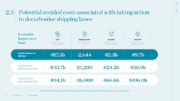
Ensuring market access: Turning decarbonisation into economic advantage
Shipping is the backbone of Aotearoa New Zealand’s economy. Almost all our trade moves by sea – 99.7 per cent by volume and 81 per cent by value – making […]
Continue reading
Shipping is the backbone of Aotearoa New Zealand’s economy. Almost all our trade moves by sea – 99.7 per cent by volume and 81 per cent by value – making […]
Continue reading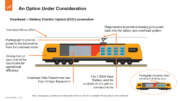
This article sets out KiwiRail’s thinking on decarbonisation, which concluded that battery electric locomotives were the right choice for the future. Building on that, KiwiRail have developed outline plans for moving to electric propulsion for the Auckland-Hamilton-Tauranga lines (the “Golden Triangle”).
Continue reading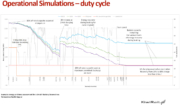
This article summarises an internal KiwiRail study recommending electrification based on a mix of extending overhead line electrification (“OLE”) and battery electric locomotives as the preferred path to decarbonising the KiwiRail mainline locomotive fleet by 2050. The article focuses on the technical rather than the business aspects of the issue.
Continue reading
In 2024, KiwiRail set an ambitious carbon emissions reduction target to reduce gross Scope 1 and 2 carbon emissions by 40 per cent by 2035 against a 2018/19 baseline. This ambitious but feasible target supports Kiwirail’s long-term goal to be net zero carbon by 2050.
Continue reading
While some of the technology behind railway engineering and operations has been around for many years, the sector continues to evolve to address challenges including decarbonisation, digitisation, asset management and safety, and the risks of climate change.
Continue reading
Green hydrogen company Hiringa Energy (Hiringa) has launched Australasia’s first zero-emissions green hydrogen refuelling network, set to help move New Zealand towards its net-zero carbon emissions goal by 2050.
Continue reading
In a promising move to the future, New Zealand’s first two battery-powered Scania trucks have hit the road in South Auckland – paving the way for other large transport companies to follow suit.
Continue reading
The Ministry of Business, Employment and Innovation engaged Andreas Heuser and his team to determine some detailed modelling and analysis for the supply-demand, and distribution of hydrogen – including potential export markets.
Continue reading
This information is only available to CILT members. Please click “Member log in” at the top of the page. Learn more about becoming a member
Continue reading
Murray King talks to Peter Reidy, back at KiwiRail since August 2022 as CEO, to find out what’s coming down the line for the company.
Continue reading
In sectors like electricity generation, or polluting manufacturing, system-level changes can be implemented by influencing the behaviour of a manageable number of players. In transport, however, decarbonisation does not occur until millions of vehicle-owning households choose to adopt cleaner transport technologies or modes. Influencing their choices is much more challenging.
Continue reading
The article presents some challenges to our members as they assess their own businesses for carbon footprints, carbon reduction and carbon offsetting.
Continue reading
Unsurprisingly, the Emissions Reduction Plan – released on May 16 – requires actions across every sector of the economy including transport, energy and industry, building and construction, agriculture, forestry, waste and fluorinated gases.
Continue reading
This year’s National Forum will focus on the Decarbonisation Challenge. Bringing together a panel of experts, the Forum will take the form of a facilitated discussion with a set of critical questions developed in advance.
Continue reading
The 2021 CILT Annual Awards Dinner will follow the annual forum that will be focussing on The Challenges of Decarbonisation.
Continue reading