An interview with TAIC Chief Commissioner David Clarke
David Clarke oversees the Commission that produces those investigative reports. As Chief Commissioner since December 2022, his role is to establish not just what happened, but the systemic conditions that made it more likely. Transport & Logistics NZ put the big questions to him directly.
1. Looking across TAIC’s recent investigations (Port Otago, the Aratere, the Shiling, Black Cat) do you see common conditions that allowed these incidents to develop, or does each tell a different story?
While each incident has its own circumstances and causes, many share familiar safety factors: weaknesses in control of safety-critical change, drift from formal procedure into routines that may feel practicable for those ‘on the ground’ but are in fact more risky, and gaps in oversight that allow problems to build before they become visible.
On the Aratere, the project for the new steering system change lacked a holistic management view to include human factors. The rail wagon runaway at Port Otago was made more likely by a poor safety culture and training issues; and Shiling showed the risk of deferred maintenance and a ship being in very poor condition despite valid certificates. Black Cat is still the subject of an ongoing inquiry, so I would not want to pre-empt any findings.
The broader lesson is that the event on the day is often the last moment in a longer chain of inflections. And it is strategic leaders who should have that long chain view.
Reports by the Transport Accident Investigation Commission are particularly helpful for the decisions of strategic leaders because we look hard at the systemic conditions and circumstances that made the incident or accident more likely, not just the proximate cause.
2. “Safety culture” is a phrase that gets used a lot. From an investigator’s perspective, what does poor safety culture actually look like day to day, before anything goes wrong?
TAIC’s recent report on the wagon runaway at Port Otago describes safety culture as the shared values, beliefs, attitudes and patterns of behaviour that shape how people think about and act on safety. How employees go about their day-to-day work will be reflective of safety culture so observable behaviours amongst the workforce offer a valuable insight. Often what starts as a small safety deviation or procedural workaround can become a widespread practice within an organisation eventually leading to a desensitisation to risk.
This is why TAIC looks beyond the behaviour and asks why people feel it’s a good idea at the time. Not every accident can be attributed to a poor safety culture, but issues like deadlines, inadequate resourcing or training can indicate that safety is not actually the organisation’s top priority. This can lead to resignation or complacency amongst workers – you’ll see this when workers view a safety briefing or toolbox talk as just box-ticking exercise. This is characteristic of poor safety culture.
Another sign to look out for is the absence of a just culture. If people fear embarrassment, blame or career consequences for speaking up, important safety information will never reach those who need to hear it. The results can be tragic. Several recent TAIC investigations have highlighted situations where organisational leaders lacked an accurate picture of what was happening at the operational front line. By the time they knew of the problem, it was too late; the risk was already embedded in everyday practice.
3. What does good safety culture look like in practice; is there a specific element you’d point to as the clearest indicator that an organisation has it?
Every good safety culture has leaders genuinely committed to safety. While there will always be a natural tension between balancing production goals with safety protections, workers should never feel they need to make unsafe choices to get a job done.
One of the clearest indications of a healthy safety culture is that people are willing to report the precursors to accidents — the mistakes and near misses that could easily be covered up because nobody saw them and nobody was hurt at the time. Organisations with strong safety cultures thoroughly understand their risks. Rather than assuming how their employees are operating on the frontline, they proactively close the gap between ‘work-as-imagined’ and ‘work-as-done.’ In short, they’re not relying on the absence of accidents or incidents as evidence that everything is working well.
4. TAIC’s role is to establish what happened. When you publish a report, what do you most want the broader sector (not just the operator involved) to take from it?
Our role is to identify systemic issues. Because they are systemic, they have much broader application. They are relevant not just to that incident and operator but could manifest in many different circumstances. We want people to read our reports with this broad reach in mind — not limited to the circumstances of the particular incident. The key question for every reader should be: “Could something like this happen in my organisation?” If the answer is even “possibly”, there is an opportunity to learn without paying the price of an accident.
5. Are there areas of New Zealand’s transport sector where you think the regulatory framework needs to be strengthened before the next incident, rather than in response to one?
Yes. In fact, many of TAIC’s recommendations are directed at regulators because strengthening the regulatory framework is often the most effective lever for achieving enduring, sector-wide safety improvements.
Recent investigations have highlighted opportunities to strengthen areas such as safety-critical change management, assurance of maintenance standards, oversight of training and competency systems, and the quality of information available to regulators about emerging operational risks. That’s because regulatory settings help organisations identify and manage risks before those risks contribute to an accident.
TAIC’s recommendations are intended to help leaders build highly effective safety systems that create multiple opportunities to detect and correct safety issues before they’re revealed by a serious accident.
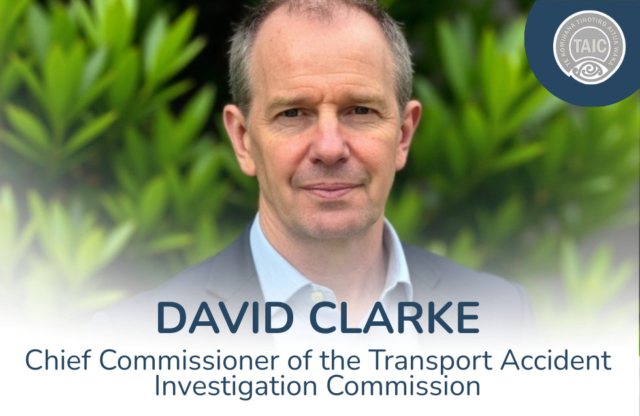
David is a senior lawyer with 27 years of legal professional experience that includes litigation, and corporate and commercial advice for private and listed company boards and public entities. David brings over 20 years’ experience in governance roles in the commercial, public and charitable sectors, including in Chair, finance and audit and risk roles. David was appointed to the Commission in December 2022. His term expires on 30 November 2030.