New report calls for stronger use of cost-benefit analysis in infrastructure investment
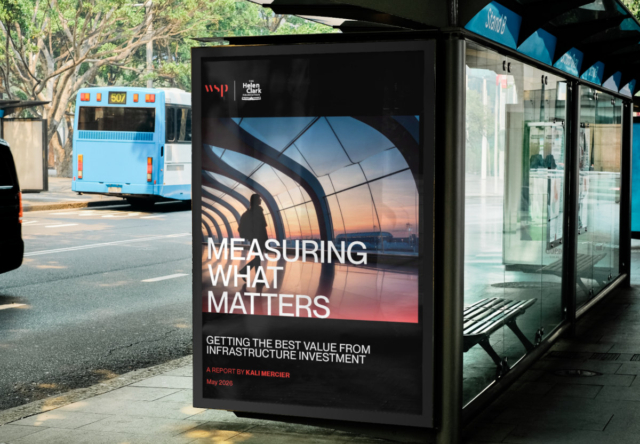
New Zealand spends billions of dollars on infrastructure every year. It routinely can’t say whether any of it worked.
That’s the blunt finding of a new report from engineering firm WSP and the Helen Clark Foundation, Measuring What Matters — Getting the Best Value From Infrastructure Investment. The report set out to answer a simple question: does New Zealand actually check whether infrastructure spending delivers what it promises? The answer, in most cases, is no.
The numbers back that up. Fewer than a quarter of infrastructure bids put to the Infrastructure Commission over the past five years included a cost-benefit analysis, the standard tool for weighing up whether a project’s social, environmental, and economic benefits justify its cost. Of six major infrastructure-intensive central government agencies contacted for the report, only two, NZTA and Kāinga Ora, use cost-benefit analysis consistently as part of their investment decisions. Health NZ has no framework at all for measuring the health benefits of the infrastructure it builds. Corrections has no standardised methodology either. In other words, most of government is making multi-billion-dollar calls without a shared, disciplined way of testing whether they stack up.

A new report from engineering firm WSP and the Helen Clark Foundation set out to see if infrastructure spending delivers what it promises? PHOTO: PEXELS
The report lands against the backdrop of a $193 billion pile of unfunded projects sitting in the national infrastructure pipeline. Report author Kali Mercier described the pipeline in blunt terms: it’s “just a big pile of projects,” not a prioritised plan. There’s no consistent mechanism forcing agencies to rank projects by value, or to demonstrate that the most urgent or highest-return projects are the ones that get funded first.
“We don’t routinely check whether projects achieved the outcomes they were funded to deliver,” Mr Mercier said. That’s arguably the most damning line in the report. It’s not just that business cases are weak going in. Nobody circles back afterwards to see if the money was well spent.
The report’s recommendations are direct and, on the face of it, uncontroversial: make cost-benefit analysis mandatory for major central government infrastructure investment; strengthen the Infrastructure Commission’s oversight role, including publishing business cases so they can be scrutinised; and build in routine post-implementation evaluations, so projects are judged not just on their pitch but on their delivery.
This isn’t an abstract governance debate. Every port upgrade, rail corridor, freight hub, and road project competing for a share of that $193 billion pipeline is, in effect, competing on the strength of its evidence. Projects backed by a disciplined, well-evidenced business case are better placed to survive budget scrutiny and political change than those riding on momentum or advocacy alone. As Wellington moves toward tighter fiscal settings and greater public scrutiny of spending, the logistics and transport projects that can show their working (clear costs, clear benefits, a credible before-and-after evaluation plan) will be the ones that get across the line.
There’s also a sector-specific angle worth watching. Land transport has historically been one of the more mature users of cost-benefit analysis in government, largely because NZTA’s funding model has long required it. That gives the sector a head start if cost-benefit analysis does become mandatory across the board, but it’s not a reason for complacency. The report’s criticism is aimed at the system as a whole, and a rising standard of scrutiny for hospitals, corrections facilities, and water infrastructure will likely raise expectations for transport business cases too, not lower them.

The report’s criticism is aimed at the system as a whole PHOTO: UNSPLASH
There’s a harder edge to this too, worth stating plainly for members. If cost-benefit analysis becomes mandatory across government, the agencies with the least mature practice (Health NZ, Corrections, and others named in the report) will need to build capability quickly. They’ll likely be competing for the same pool of analysts and advisors that transport agencies already draw on. That’s not necessarily bad news for the sector’s consultants and advisory firms. But it does mean the “easy” projects with obvious, well-documented benefits will get funded first. More complex or contested transport investments, anything with diffuse benefits, long payback periods, or politically awkward trade-offs, will face a harder time justifying themselves under tighter scrutiny. Members involved in early-stage project scoping should treat this as a signal to invest in the business case earlier and more rigorously than they might have in the past, rather than treating cost-benefit analysis as a box-ticking exercise added late to satisfy a funder.
The Northland Expressway is a live example of exactly the problem the report describes. The last publicly available benefit-cost ratio for the project’s first stage, a 26km four-lane highway from Warkworth to Te Hana including an 850m tunnel through Dome Valley, was 0.7, from a 2019 business case that predates Covid-era construction cost inflation. That means every dollar spent was projected to return 70 cents in benefits, well below the threshold that would normally justify proceeding. The Government has declined to release updated cost and BCR figures while it finalises a public-private partnership deal, arguing disclosure could undermine its negotiating position. Transport advocate Connor Sharp put the sceptical read on that bluntly: the implication, he said, is that the BCR is so bad that releasing it would make the project untenable. Whether or not that’s the case, it’s a live illustration of the report’s core complaint: a major, multi-billion-dollar project moving toward contract signing without the public seeing a current cost-benefit case at all.