Golden Triangle Electrification Project
Option under consideration: Overhead-Battery Electric Hybrid Locomotive
The article in this edition by Michael McKeon sets out KiwiRail’s thinking on decarbonisation. It concluded that battery electric locomotives were the right choice for the future. Building on that, KiwiRail have developed outline plans for moving to electric propulsion for the Auckland-Hamilton-Tauranga lines (the “Golden Triangle”).
Walter Rushbrook set out the key points in a presentation to the recent CILT Forum in Wellington
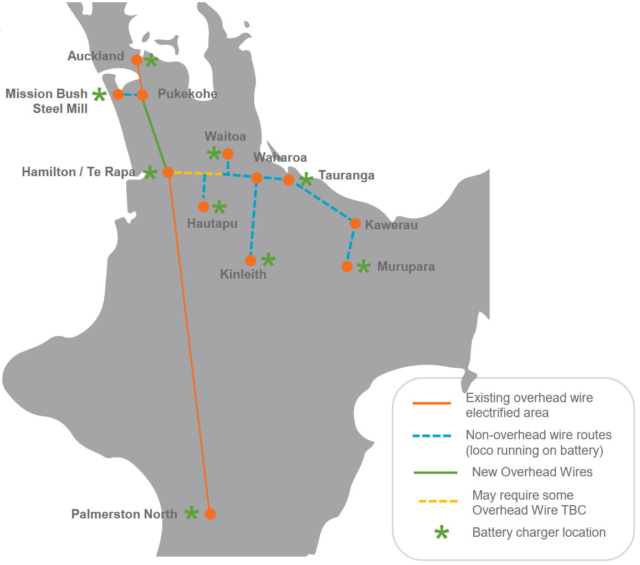
Already the route is partially electrified, in the Auckland metro area as far south as Pukekohe. As well, there is existing NIMT electrification between Palmerston North and Te Rapa in Hamilton. That leaves two relatively short (80-100km) gaps in the Golden Triangle (Pukekohe-Te Rapa on the North Island Main Trunk, and Hamilton –Tauranga on the East Coast Main Trunk.
The Golden Triangle is the busiest part of the rail freight network, carrying nearly half of all freight traffic on rail, and has capacity to grow. Prioritising decarbonisation investment in this area would help achieve the greatest reduction in freight carbon emissions from rail.
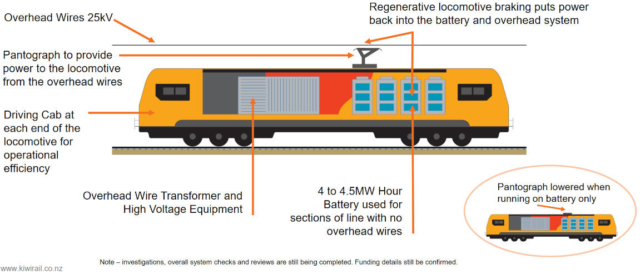
The project has further developed the locomotive ideas in the decarbonisation report. An option being considered is a hybrid overhead-battery electric locomotive.
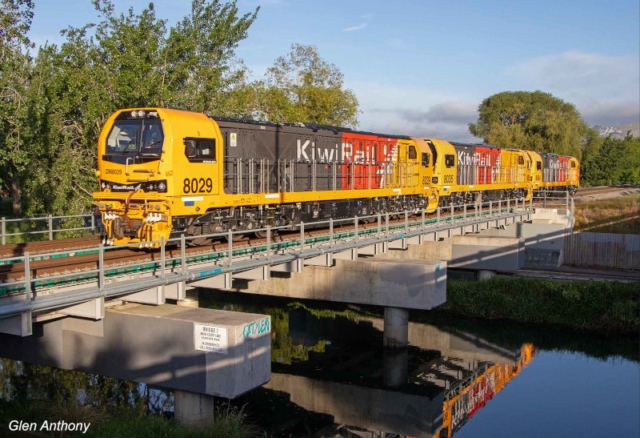
DM locomotives 8035, 8064 and 8029 on their way to Middleton, crossing the Heathcote River as train J21. Photo by Glen Anthony 2/11/2025
This has a pantograph for drawing current directly from OHL (Overhead Lines) wires, and a 4-4.5 MWH battery for non-wired sections. The pantograph is lowered when running on battery. The locomotive battery would predominantly charged at rail terminals during the strip and re-loading of the train. There is the option for some trickle charging of the battery in the overhead sections of the route and from regenerative braking.
The locomotive has a driving cab at each end to enable efficient operations. It is proposed that OHL would be provided for the NIMT gap between Pukekohe and Te Rapa. Possibly a short distance of OHL east of Hamilton may be required (depending on the final locomotive battery size), but the locomotive would rely on batteries elsewhere (including branch lines and lines east of Mt Maunganui). Static charging facilities would be required for this at a number of terminals, as shown on the map.
This is a long lead time programme still in the early development phases. Subject to obtaining delivery funding, the target is to build the infill OHL and buy a batch of hybrid locomotives by 2035.
Operations
When in operation, freight trains between Auckland and Tauranga would use the overhead power between Auckland and Te Rapa then mostly move on battery power between Te Rapa and Tauranga No locomotive change would be required for the journey.
While the train is unloaded and re-loaded in Tauranga the hybrid loco battery would be re-charged to travel back to Te Rapa.
The hybrid locomotive also has the capability and range to serve all the Golden Triangle feeder lines and operate between Auckland and Palmerston North.
If desired in future, the hybrid solution could be relatively easily scaled up for all North Island routes by leveraging off the initial technology investment.
Benefits and opportunities
- Responds to customer expectations for low or zero carbon heavy freight options in the supply chain.
- Helps ensure that New Zealand’s exports remain attractive to overseas countries plus avoids carbon tariffs and other trade barriers.
- Enables KiwiRail to contribute to New Zealand’s GHG emission reduction targets for the wider land transport sector by providing a low-carbon heavy freight option.
- Help to reduce rail’s operating and energy costs to provide an efficient transport option (including removing international exposure to fossil fuel price volatility).
- Enables Auckland metro electric multiple unit passenger trains to run south of Pukekohe
- Helps support establishment of decarbonised regional passenger and tourism train operations
- Electrification removes the Kaimai Tunnel diesel fume issues which could constrain rail volume growth
- Charging infrastructure created for rail electrification could also be used for other electric vehicle charging (e.g. reach stackers and first/last mile vehicles at intermodal hubs; private vehicles at locations along the rail corridor)
Next steps
At the time of presentation, internal KiwiRail reviews are being undertaken. The business case will be shared with Government and other stakeholder in due course.
It is anticipated that the next programme stage will be a further development phase to take the Golden Triangle electrification planning to the next level of detail. This work would then be used to support obtaining the implementation funding.
Large programmes like the Golden Triangle Electrification Programme take time to consider and develop, so it is important to start thinking about them now.